
 |


Material: Glass fiber or carbon fiber reinforced polymer composites.
Resin Options: Polyester, vinyl ester, epoxy, phenolic, urethane, and customized resin blends.
Reinforcement: Fiberglass rovings, continuous mats, woven fabrics, stitched fabrics, and carbon fibers.
Profile Design: Customized constant cross-sections according to technical drawings.
Key Features: Lightweight, high strength, corrosion resistant, abrasion resistant, waterproof, and heat resistant.
Customization: Flexible resin formulations, fiber arrangements, composite structures, and colors.
Manufacturing: Continuous pultrusion process with heated die curing.
Applications: Construction, industrial equipment, infrastructure, and customized structural components.
Different engineering and industrial projects require composite profiles with specific cross-sectional shapes, mechanical properties, and environmental resistance. Standard fiberglass products may not always satisfy specialized design requirements. Our GRP Pultrusions provide a flexible manufacturing solution, allowing customers to customize profile geometry, resin systems, reinforcement materials, and composite structures according to their applications.
GRP (Glass Reinforced Plastic) is a composite material combining reinforcing fibers with a polymer resin matrix. Also known as FRP Pultruded Profiles or fiberglass reinforced polymer profiles, these products are manufactured through a continuous pultrusion process. This manufacturing method produces profiles with consistent cross-sectional shapes and allows different composite configurations to be developed for specific engineering requirements.
Unlike standard off-the-shelf pultruded products, Custom GRP Pultruded Profiles allow adjustments to several important material and manufacturing elements. Customers can select polyester, vinyl ester, epoxy, phenolic, urethane, or blended resin systems. Reinforcement options include fiberglass and carbon fibers in different forms, such as continuous multi-filament strands, mats, woven fabrics, and stitched fabrics.
The combination of resin formulation, reinforcement type, fiber arrangement, and composite structure determines the properties of the finished product. With flexible customization options, our GRP Composite Profiles can be developed for industrial structures, construction components, equipment frameworks, and other applications requiring lightweight and durable composite materials.
Custom GRP pultrusions are fiber-reinforced polymer products manufactured through continuous pultrusion and customized according to customer-specific requirements. The customization process can involve one or more aspects of the product, including profile shape, resin matrix, reinforcement materials, and composite design.
One of the main advantages of pultrusion is the ability to manufacture profiles with different constant cross-sections. By developing suitable production dies, manufacturers can produce a wide range of fiberglass structural shapes to meet different design requirements.
Round Tubes: Hollow circular profiles for tubular structural components and industrial frameworks.
Square Tubes: Square hollow profiles for support structures and equipment assemblies.
Rectangular Tubes: Rectangular hollow sections for customized structural applications.
U Channels: Open-channel profiles for structural supports and component connections.
C Channels: Channel-shaped profiles for frameworks and structural assemblies.
I Beams: I-shaped profiles for applications requiring specific structural configurations.
L Angles: Angle profiles for reinforcement, brackets, and structural connections.
Special Profiles: Customized constant-section designs developed according to customer drawings.
The profile shape, dimensions, wall thickness, and cross-sectional structure can be discussed according to the intended application and manufacturing feasibility. Customers can provide technical drawings or reference samples to help evaluate the required profile design.
The resin matrix is an essential component of GRP composite materials. It binds the reinforcing fibers together and influences the finished profile's mechanical, thermal, chemical, and environmental properties. Different resin systems can be selected according to the required performance and operating conditions.
| Resin Type | Main Characteristics | Selection Considerations |
|---|---|---|
| Polyester Resin | General-purpose thermosetting resin for fiberglass composite manufacturing. | General industrial and structural applications. |
| Vinyl Ester Resin | Suitable for demanding corrosion and chemical exposure conditions. | Chemical processing and corrosive environments. |
| Epoxy Resin | A resin system used in composite designs requiring specific mechanical and bonding properties. | Specialized engineering and structural applications. |
| Phenolic Resin | A thermosetting resin option for specialized thermal and fire performance requirements. | Applications requiring specific heat and fire characteristics. |
| Urethane Resin | A resin category available for specialized composite formulations. | Customized material requirements. |
| Resin Blends | Customized combinations of resin components. | Specific application and performance requirements. |
Selecting the appropriate resin matrix is important for achieving the desired product performance. Factors such as operating temperature, chemical exposure, moisture, and mechanical loading should be considered during material selection.
Reinforcing fibers provide the structural foundation of GRP pultruded profiles. Different fiber types and reinforcement forms can be combined to develop composite structures with different mechanical characteristics.
Fiberglass Roving: Continuous glass fiber strands that provide longitudinal reinforcement in pultruded profiles.
Continuous Fiberglass Mat: Provides additional reinforcement throughout the composite structure.
Woven Roving: Woven fiberglass reinforcement for customized fiber arrangements.
Woven Fabrics: Fabric-based reinforcement materials for specific composite designs.
Stitched Fabrics: Reinforcement fabrics with different fiber orientations for customized structural requirements.
Carbon Fiber: An alternative reinforcement material for specialized composite applications.
The type, form, and positioning of reinforcement materials influence the strength, stiffness, and directional properties of the finished profile. By selecting appropriate reinforcement combinations, Custom FRP Pultruded Profiles can be designed for different loading and operating conditions.
In addition to selecting the resin and reinforcement materials, the internal composite structure can also be customized. The resin mixture, fiber type, reinforcement form, and positioning of fibers within the profile all contribute to the final material characteristics.
For example, continuous fiberglass rovings can provide reinforcement along the profile's longitudinal direction, while mats and woven fabrics can contribute reinforcement in other directions. Adjusting the reinforcement combination and distribution helps manufacturers develop composite structures according to specific mechanical and application requirements.
This flexibility makes Customized GRP Profiles suitable for projects where standard fiberglass products cannot fully meet the required material or structural specifications.
GRP pultruded profiles combine reinforcing fibers with a polymer resin matrix to form rigid composite structures. Fiberglass reinforcement provides mechanical strength, while the option of carbon fiber reinforcement allows additional flexibility for specialized composite designs.
The combination of fiber type, reinforcement arrangement, and resin formulation influences the strength and stiffness of the finished profile. This makes High Strength GRP Profiles suitable for consideration in structural supports, industrial frameworks, equipment assemblies, and customized engineering components.
For load-bearing applications, buyers should evaluate tensile strength, flexural strength, modulus, loading direction, and structural design conditions before selecting a profile.
One of the important characteristics of fiberglass reinforced polymer materials is their relatively lightweight construction compared with many conventional metal materials. Lightweight FRP Pultruded Profiles can simplify handling, transportation, and installation, particularly for projects involving large structures or multiple profile components.
Reducing component weight can also provide additional flexibility in prefabricated structures and industrial equipment design. The actual weight depends on profile geometry, dimensions, reinforcement content, and resin formulation.
Corrosion can increase maintenance requirements and affect the service life of structural components in demanding industrial environments. Corrosion Resistant GRP Pultrusions provide an alternative to conventional metal profiles where moisture and chemical exposure are important considerations.
The polymer resin matrix helps protect the reinforcing fibers. Different resin systems can be selected according to environmental conditions and chemical compatibility requirements. Vinyl ester resin, for example, can be considered for demanding corrosion-related applications.
For chemical environments, buyers should confirm the chemical type, concentration, temperature, and exposure duration before choosing the resin system.
Fiberglass reinforced polymer composites generally have lower thermal conductivity than conventional metallic materials. This characteristic makes GRP Thermal Insulation Profiles worth considering for applications where reduced heat transfer is important.
The thermal properties and maximum service temperature depend on the selected resin system, fiber reinforcement, and composite formulation. For applications involving continuous high-temperature exposure, buyers should confirm the operating temperature range and relevant test results before ordering.
Industrial structural components may experience repeated contact, friction, and surface wear during operation. The product specifications describe GRP pultrusions as abrasion-resistant, making them worth considering for applications where surface durability is an important requirement.
Actual abrasion performance depends on the resin formulation, reinforcement structure, surface condition, and operating environment. For specialized wear-related applications, the relevant test method and acceptance criteria should be confirmed.
The combination of reinforcing fibers and thermosetting resin creates a composite structure designed for industrial and environmental applications. Anti-aging is one of the product characteristics listed on the original product page.
For outdoor applications, ultraviolet exposure, humidity, temperature fluctuations, and chemical conditions should be considered during material selection. Appropriate resin formulations and additional surface protection may be required according to the intended service environment.
GRP composites provide resistance to moisture under suitable operating conditions. This characteristic makes fiberglass pultruded profiles worth considering for construction, infrastructure, and industrial applications where water exposure is a concern.
For continuous immersion or specialized chemical environments, the resin system and complete composite design should be evaluated according to the actual working conditions.
Unlike standard off-the-shelf profiles, customized GRP pultrusions allow buyers to discuss profile geometry, resin formulations, reinforcement materials, and composite structures according to project requirements.
The product page also lists colorful customization as one of its product characteristics. Customers can communicate their preferred appearance and color requirements during the product development and quotation stages.
The GRP Pultrusion Process is a continuous manufacturing method used to produce fiberglass reinforced polymer profiles with constant cross-sections. It combines reinforcing fibers and a polymer resin matrix through controlled impregnation, pre-forming, heating, and curing.
The manufacturing process begins with selecting the required reinforcement fibers, resin systems, minerals, pigments, and additives. The material combination is determined according to the intended product design and performance requirements.
Fiberglass rovings, continuous mats, woven rovings, carbon fibers, or other suitable reinforcement materials are arranged according to the composite design. The reinforcement combination helps determine the structural properties of the finished profile.
The reinforcing fibers pass through a resin impregnation system, where they are saturated with the selected polymer matrix. The resin may contain minerals, pigments, and other additives according to the required formulation.
After impregnation, the resin-coated reinforcement materials pass through a pre-forming station. This stage arranges the fibers into the required cross-sectional configuration and establishes the reinforcement distribution needed for the intended product properties.
The prepared reinforcement is continuously pulled through a heated die. The die determines the profile's cross-sectional shape, while controlled heating causes the thermosetting resin to cure and form a rigid composite structure.
After curing, the finished composite profile is continuously pulled from the heated die and cut to the required length. Additional finishing and dimensional inspection can be performed according to the product specifications.
This continuous production method supports the manufacture of GRP Pultruded Profiles with repeatable cross-sections and customized composite material configurations.
With their lightweight construction, mechanical strength, corrosion resistance, and customizable composite structures, Industrial GRP Profiles can be considered for a wide range of engineering and manufacturing applications.
| Industry | Typical Applications | Relevant Material Characteristics |
|---|---|---|
| Construction | Structural supports, building frameworks, customized profiles, and construction components. | Lightweight construction, strength, and design flexibility. |
| Industrial Manufacturing | Equipment frames, machine supports, industrial structures, and customized components. | Corrosion resistance, mechanical strength, and customized profile geometry. |
| Chemical Processing | Structural supports and components in chemical processing facilities. | Resin-dependent chemical resistance. |
| Power and Electrical Infrastructure | Non-conductive supports and customized electrical infrastructure components. | Electrical insulation properties and lightweight construction. |
| Marine Engineering | Structural supports and composite components in moisture-exposed environments. | Corrosion resistance and reduced weight. |
| Transportation | Customized lightweight structural and equipment components. | Lightweight composite construction and flexible design. |
| Water Treatment | Industrial supports and structural components in water treatment facilities. | Moisture resistance and suitable resin selection. |
The actual suitability of each GRP profile depends on its cross-sectional design, reinforcement arrangement, resin formulation, and working environment. Buyers should provide their project details to evaluate the appropriate composite configuration.
When selecting materials for industrial and structural applications, buyers often compare GRP pultruded profiles with conventional steel and aluminum profiles. Each material has different mechanical and environmental characteristics. The appropriate choice depends on structural loading, corrosion exposure, electrical requirements, and project costs.
| Evaluation Factor | GRP Profiles | Steel Profiles | Aluminum Profiles |
|---|---|---|---|
| Weight | Generally lightweight. | Generally heavier. | Generally lightweight. |
| Corrosion Resistance | Good, depending on resin selection. | May require protective coatings. | Good in many environments. |
| Electrical Conductivity | Generally non-conductive. | Conductive. | Conductive. |
| Thermal Conductivity | Relatively low. | Generally high. | Generally high. |
| Profile Customization | Customized constant cross-sections through pultrusion tooling. | Depends on forming and fabrication processes. | Depends on extrusion and fabrication capabilities. |
| Fabrication | Cutting, drilling, bonding, and mechanical fastening. | Cutting, drilling, and welding. | Cutting, drilling, and suitable joining methods. |
GRP profiles are worth considering when lightweight construction, corrosion resistance, electrical insulation, and customized composite structures are important. However, they are not direct replacements for every metal profile. Buyers should evaluate mechanical properties, structural requirements, connection design, and total project costs before selecting a material.
Customized pultruded profiles require coordination between cross-sectional design, resin selection, fiber reinforcement, and manufacturing tooling. Providing accurate technical information at the beginning of the development process helps manufacturers evaluate the feasibility of the required product.
For a customized GRP pultrusion project, buyers should prepare the following information:
Technical Drawings: Cross-sectional drawings, dimensions, and product specifications.
Profile Shape: Round, square, rectangular, U-shaped, C-shaped, I-shaped, L-shaped, or other constant cross-sections.
Resin Requirements: Polyester, vinyl ester, epoxy, phenolic, urethane, or customized resin blends.
Reinforcement Requirements: Fiberglass roving, continuous mat, woven fabrics, stitched fabrics, or carbon fiber.
Composite Design: Required fiber arrangement, reinforcement distribution, and material structure.
Mechanical Requirements: Tensile strength, flexural strength, stiffness, and loading conditions.
Environmental Conditions: Operating temperature, humidity, chemical exposure, and outdoor conditions.
Appearance Requirements: Preferred color and surface finish.
Order Quantity: Estimated purchasing quantity, sample requirements, and delivery schedule.
Providing technical drawings, reference samples, and application details helps the manufacturer evaluate suitable resin systems, reinforcement arrangements, profile designs, and production requirements.
Consistent quality is important for GRP pultruded profiles used in industrial and structural applications. Material selection, fiber arrangement, resin impregnation, curing conditions, and dimensional control all contribute to the quality of the finished composite product.
The company states that its quality management system has passed ISO 9001:2015 certification and that products undergo double checking before packaging.
Depending on the product specifications and project requirements, quality evaluation may include:
Dimensional Inspection: Checking profile dimensions, cross-sectional geometry, and dimensional consistency.
Surface Inspection: Checking for visible cracks, exposed fibers, uneven surfaces, and other defects.
Material Verification: Confirming the selected resin system and reinforcement materials.
Mechanical Testing: Evaluating tensile, flexural, and other relevant mechanical properties.
Environmental Performance: Reviewing corrosion, temperature, and other application-specific requirements.
Final Inspection: Checking finished products before packaging and shipment.
Specific test reports, inspection standards, and certification documents can be confirmed according to the actual product and customer requirements.
Selecting a reliable GRP Pultrusion Manufacturer is important for developing customized composite profiles and maintaining production consistency. Shanxi Taiyun Building Materials Co., Ltd. integrates design, research and development, customization, and production, providing fiberglass reinforced polymer profile solutions for different customer requirements.
According to the company's product information, it has 20 years of production experience in Shanxi and specializes in fiberglass and polymer pultruded profiles.
Key purchasing and cooperation advantages include:
20 Years of Production Experience: Experience in fiberglass and composite profile manufacturing.
Customized Profile Design: Flexible profile shapes, reinforcement combinations, and resin formulations.
Multiple Material Options: Different resin systems and reinforcement materials for various project requirements.
Quality Management: ISO 9001:2015 quality management system certification as stated on the product page.
Sample Support: Certain samples can be provided free of charge, with freight paid by the customer.
Flexible Delivery Arrangements: Production and delivery schedules can be discussed according to order quantity and specifications.
Payment Options: 50% deposit with the balance before shipment, or L/C at sight, as listed on the product page.
Whether you are a construction contractor, industrial equipment manufacturer, engineering company, or building material distributor, our team can discuss customized GRP pultrusion solutions based on your technical drawings and project requirements.
GRP pultrusions are glass fiber reinforced polymer profiles manufactured through a continuous pultrusion process. They combine reinforcing fibers with a thermosetting resin matrix to produce composite profiles with constant cross-sectional shapes. Depending on the tooling and material design, GRP pultrusions can be manufactured in different structural configurations for industrial and construction applications.
GRP stands for Glass Reinforced Plastic, while FRP stands for Fiber Reinforced Plastic. GRP specifically refers to polymer composites reinforced with glass fibers, whereas FRP is a broader term that can include glass fiber, carbon fiber, and other reinforcement materials. Therefore, GRP pultruded profiles are a type of FRP pultruded profile.
The pultrusion process can manufacture profiles with different constant cross-sections. Common shapes include round tubes, square tubes, rectangular tubes, U channels, C channels, I beams, and L angles. Customized profile shapes can also be discussed according to customer drawings and manufacturing feasibility.
The resin options listed for customized GRP pultrusions include polyester, vinyl ester, epoxy, phenolic, urethane, and resin blends. Each resin system has different material characteristics. Selection should be based on the required mechanical properties, operating temperature, chemical exposure, and other environmental conditions.
Common reinforcement materials include fiberglass rovings, continuous fiberglass mats, woven rovings, woven fabrics, and stitched fabrics. Carbon fibers can also be used in specialized composite designs. The reinforcement type, form, and arrangement influence the mechanical properties and structural performance of the finished profile.
Yes. Customized GRP pultrusions can be developed according to customer requirements for profile shape, dimensions, resin systems, reinforcement materials, and composite structures. Buyers can provide cross-sectional drawings, dimensions, reference samples, and application details for technical evaluation and quotation.
GRP pultruded profiles offer lightweight construction, corrosion resistance, electrical insulation, and flexible composite design. These characteristics make them suitable for applications where conventional metal profiles may require additional corrosion protection or where non-conductive structural materials are preferred. The final material selection should consider mechanical requirements and project conditions.
GRP pultruded profiles can be considered for outdoor applications because of their corrosion-resistant and moisture-resistant characteristics. However, ultraviolet exposure, temperature fluctuations, and environmental conditions should be considered when selecting the resin system and surface protection. Buyers should confirm the required outdoor service performance before ordering.
The product page lists a general delivery time of 7–15 days after receiving the deposit based on the minimum order quantity. For a 20-foot container order, the page states that production normally takes within 30 days. Actual delivery schedules depend on profile design, order quantity, material preparation, and production arrangements. Buyers should confirm the lead time before placing an order.
Yes. The company states that certain samples can be provided free of charge, while customers are responsible for the freight cost. Sample availability, specifications, and shipping arrangements should be confirmed with the sales team before requesting samples.
Looking for a reliable GRP Pultrusions Manufacturer for your industrial or construction project? Shanxi Taiyun Building Materials Co., Ltd. provides customized fiberglass reinforced polymer profiles, integrating product design, research and development, customization, and manufacturing.
Whether you need standard FRP structural profiles or customized pultruded composite components, our team can discuss suitable resin systems, reinforcement materials, profile shapes, and production arrangements according to your application.
Send us your technical drawings, preferred resin system, reinforcement requirements, and estimated order quantity to discuss customized GRP pultruded profiles and request a quotation.
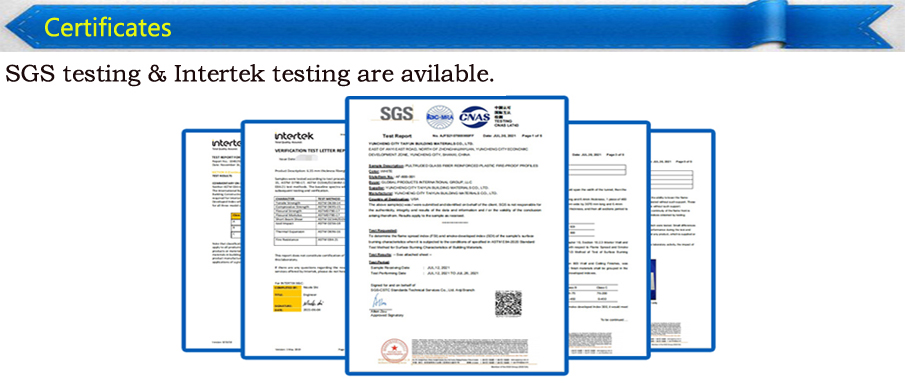
Qualification Certificates:
Processing Technique:

Custom GRP Pultrusions Profiles

Our Company

Packing and delivery


