
Views: 0 Author: Site Editor Publish Time: 2026-10-30 Origin: Site


Engineers, procurement teams, and project managers often face confusion when specifying composite materials for structural or corrosive environments. You might look at a complex engineering blueprint and wonder if you need FRP or GRP. This terminology creates unnecessary friction during the bidding and sourcing process. However, the distinction is primarily linguistic and regional, rather than fundamentally chemical. Misunderstanding these acronyms can lead to supply chain delays and incorrect material specifications.
We want to eliminate this terminology friction entirely. In the sections below, we will explain material performance standards and clarify global naming conventions. You will get a clear framework for evaluating and sourcing structural composites. We focus specifically on high-strength shapes designed for heavy-duty industrial applications, ensuring your next project avoids common specification pitfalls.
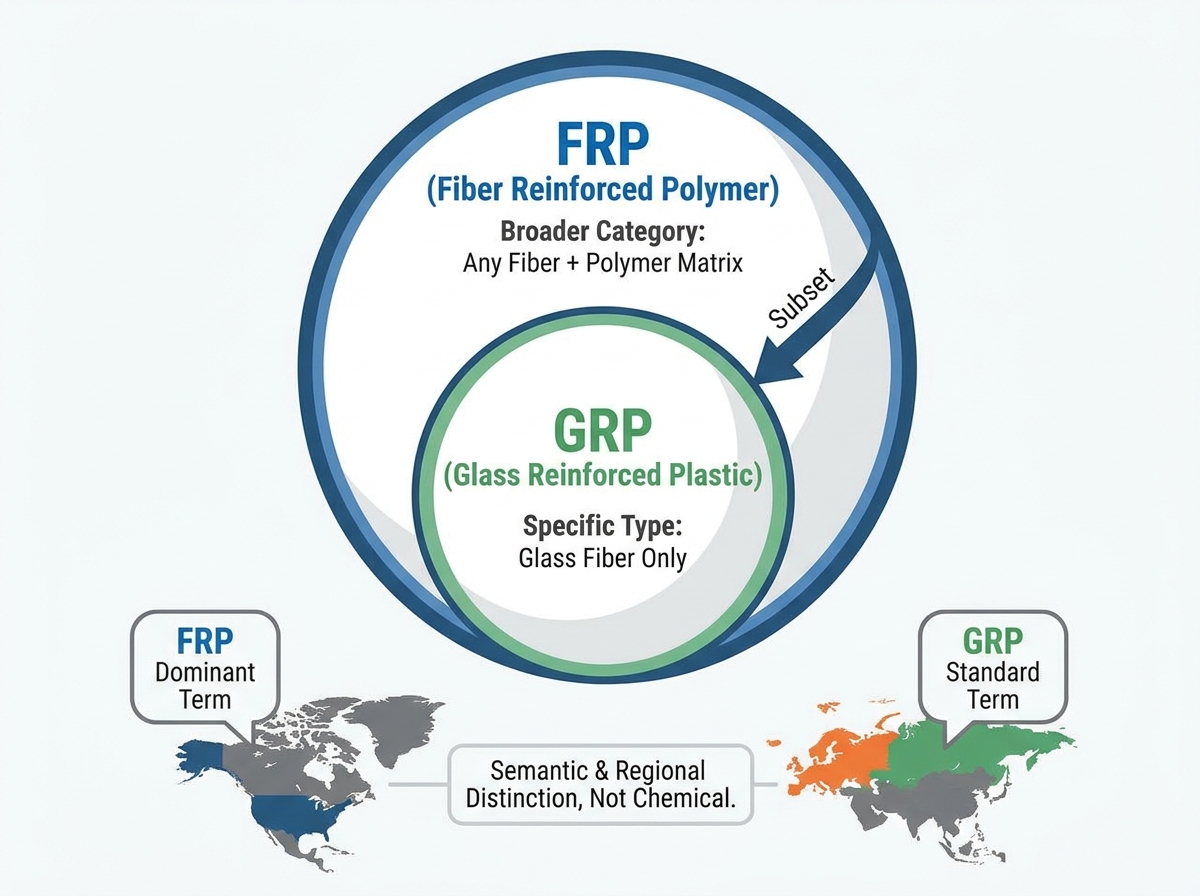
Semantic alignment: FRP (Fiber Reinforced Polymer) is the overarching material category; GRP (Glass Reinforced Plastic) is a specific type of FRP where the reinforcing fiber is glass.
Regional usage: "GRP" is the standard nomenclature in Europe and parts of Asia, while "FRP" is the dominant terminology in North America.
Specification reality: In industrial and structural applications, the terms are frequently used interchangeably by manufacturers and regulatory bodies.
Structural evaluation: The manufacturing process—specifically pultrusion—dictates the load-bearing capacity, making the selection of specific shapes like FRP pultruded profiles more critical than the FRP vs. GRP acronym debate.
Understanding composite materials requires breaking down the core terminology. Often, buyers assume different acronyms represent entirely different performance tiers. In reality, the technical distinction comes down to broad categories versus specific recipes.
FRP stands for Fiber Reinforced Polymer. Think of it as a massive umbrella category. A polymer matrix acts as the binding resin, holding a reinforcing fibrous material in place. The resin protects the fibers from environmental damage. The fibers provide all the tensile strength. Under the FRP umbrella, engineers can choose many different fiber types. You might use carbon fibers to create CFRP. You could use aramid fibers for ballistic resistance. You can even use basalt fibers for high-heat environments.
Because FRP is a broad term, simply asking a supplier for "FRP" is technically incomplete. You must specify the exact fiber type required for your load calculations. Otherwise, you risk receiving a standard glass-based product when your structural span actually required rigid carbon reinforcement.
GRP stands for Glass Reinforced Plastic. This acronym narrows the scope significantly. When you say GRP, you explicitly restrict the reinforcing fiber to fiberglass. You also restrict the matrix to plastic, which typically means thermosetting resins like polyester, vinyl ester, or epoxy.
Every piece of GRP is a type of FRP. However, not every piece of FRP is GRP. For most industrial grating, handrails, and structural beams, manufacturers use glass fibers because they offer the best balance of strength and affordability. Therefore, when people talk about structural FRP, they are almost always talking about GRP.
The interchangeable use of "plastic" and "polymer" historically drove this acronym split. Decades ago, European engineers favored the word plastic to describe the cured resin state. North American engineers preferred the broader, more chemically accurate term polymer. Modern engineering standards treat them as structurally identical in this context. Do not let the word "plastic" fool you into thinking GRP is weak. High-quality thermosetting polymers deliver incredible rigidity.
While the terms refer to similar materials, ignoring the regional nuances can disrupt large-scale industrial projects. Clear communication prevents costly delays.
Regional naming conventions deeply impact material requests for quotation (RFQs) and supplier communication. European projects typically follow EN standards, which heavily utilize the GRP acronym. American projects follow ASTM standards, where FRP dominates the literature. If a North American buyer sends an RFQ for FRP to an Asian or European manufacturer, the supplier might reply quoting GRP. Inexperienced procurement teams might reject the bid, thinking the supplier offered the wrong material. Understanding regional dialects ensures you evaluate global bids accurately.
Table: Regional Nomenclature and Standard References
Region / Standard Body | Preferred Acronym | Common Regulatory Frameworks |
|---|---|---|
North America (ASTM) | FRP (Fiber Reinforced Polymer) | OSHA, CTI, IBC |
Europe (CEN) | GRP (Glass Reinforced Plastic) | EN 13706, Eurocodes |
Middle East / Asia | Mixed (Often GRP) | ISO, BS EN, Local Codes |
Using vague acronyms introduces massive risk. Imagine requesting "FRP" when your bridge design requires high-tensile carbon fiber (CFRP). If the supplier assumes you want standard glass fiber, the resulting structure will fail to meet deflection criteria. Establishing the necessity of specifying exact resin types and fiber fractions is mandatory. Never rely on broad acronyms alone. Always list the fiber volume fraction, the exact resin chemistry, and the required physical properties.
Material test reports (MTRs) and compliance certificates must map correctly to the project design parameters. When inspectors arrive on site, they check the paperwork against the approved blueprints. If your blueprint says FRP but your certs say GRP, an overly strict inspector might halt construction. You can prevent this by adding a simple clarification note on your drawings: "FRP (Fiberglass Reinforced Polymer) and GRP (Glass Reinforced Plastic) denote the identical material system for this assembly."
Knowing the basic material chemistry is only the first step. The fabrication method ultimately determines the commercial viability for heavy load-bearing applications. How manufacturers process the glass and resin matters more than the acronym they use to sell it.
You cannot build a bridge using buckets of liquid resin and rolls of dry glass fabric. You need rigid, predictable structural shapes. Open-mold hand layup or compression molding might work for boat hulls or car bumpers. However, industrial construction demands absolute consistency. The manufacturing process dictates whether the final composite can hold up a chemical storage tank or act as a pedestrian walkway.
For structural applications, continuous pultrusion represents the gold standard. Pultrusion is an automated process where pulling devices draw continuous fiberglass rovings and mats through a liquid resin bath. The saturated fibers then enter a heated steel die. The heat triggers a chemical reaction, curing the material into its final rigid shape as it exits the die.
This automated method achieves much higher fiber-to-resin ratios compared to molded grating or hand-layup techniques. A higher fiber fraction directly translates to higher tensile and flexural strength. Pultrusion aligns the fibers precisely along the longitudinal axis, putting the strength exactly where you need it most.
Engineers evaluate FRP Pultruded Profiles based on several critical performance metrics:
Structural predictability and dimensional stability: Because pultrusion utilizes fixed steel dies, every beam comes out identical. You get predictable deflection rates and consistent wall thicknesses.
High longitudinal strength: Structures like beams, channels, angles, and custom shapes require massive stiffness along their length. Pultruded fibers run continuously down the entire part, mimicking the grain in a perfect piece of lumber.
Success criteria: You must match specific pultruded shapes to load-bearing requirements previously dominated by steel. Wide flange beams support high vertical loads, while hollow square tubes resist twisting and torsional forces.
When selecting materials for a new facility, engineers usually compare composites against traditional metallic options. The acronym you use matters less than how the material performs against steel and aluminum in the real world.
Metals rust. Galvanized steel eventually loses its protective zinc coating. Aluminum oxidizes and pits in highly alkaline environments. Composites do not rust. We can compare the initial premium of composite profiles against the long-term maintenance costs of galvanized steel. In chemically aggressive environments like wastewater plants, offshore oil rigs, or coastal facilities, metallic beams require frequent sandblasting and repainting.
By utilizing composites, facility owners eliminate these recurring maintenance cycles. The upfront material cost might be slightly higher than standard carbon steel, but the long-term lifecycle return on investment heavily favors composites. You build it once, and it survives decades of chemical exposure without degrading.
Metals are incredibly heavy. Composites are significantly lighter than their metallic counterparts. A composite wide flange beam weighs roughly one-quarter of an equivalent steel beam. This creates massive installation benefits.
Contractors need fewer heavy lifting cranes on the job site. Two workers can manually carry a 20-foot composite angle section, whereas a steel section would require a forklift. Furthermore, the lower weight reduces freight costs. You can pack more linear feet of material onto a single flatbed truck. Ultimately, lighter materials lead to faster assembly times, reducing expensive labor hours on site.
Traditional metals conduct electricity and heat very efficiently. This creates major safety hazards in certain industries. Composites showcase non-conductive and low-thermal-conductivity traits.
For railway infrastructure, utility substations, and telecommunications towers, non-conductive materials are absolutely critical. If a live wire touches a composite structural beam, the beam will not ground the current or electrocute nearby workers. Additionally, composites do not expand and contract wildly under extreme temperature changes. This thermal stability keeps bolted connections tight over time.
Specifying the right structural shapes requires deep attention to detail. You must evaluate the hidden chemical components and vet your manufacturing partners thoroughly.
The matrix you select dictates the chemical survival of your structure. You must evaluate three primary thermosetting resins based on specific chemical exposure and fire retardancy requirements:
Orthophthalic polyester (Ortho): The baseline resin. It offers moderate strength and basic environmental protection. Use it for standard structural applications away from harsh chemicals.
Isophthalic polyester (Iso): A significant upgrade. It provides excellent corrosion resistance against mild acids and alkalis. Most industrial grating utilizes Iso resin.
Vinyl ester: The premium choice. It survives highly aggressive chemical environments, including prolonged exposure to strong acids, caustics, and bleaches. It also offers higher thermal distortion temperatures.
We must transparently address the vulnerability of bare resin to UV light. Prolonged exposure to harsh sunlight breaks down the polymer chains on the surface of composites. Over time, the surface resin erodes, exposing the underlying glass fibers. This phenomenon is known as "fiber bloom."
To prevent fiber bloom, engineers mandate specific protective measures. You must specify synthetic surface veils during the pultrusion process. The veil creates a resin-rich outer layer shielding the fibers. For maximum outdoor longevity, you should also apply industrial polyurethane coatings. A quality UV coating extends the visual and structural lifespan of the profiles indefinitely.
Not all manufacturers produce high-quality structural goods. Procurement teams must deploy strict vetting frameworks before issuing purchase orders. Ask these key questions to evaluate manufacturers:
Do they possess in-house load testing and QA/QC validation equipment to prove their batch properties?
Are their FRP Pultruded Profiles fully compliant with relevant structural codes like CTI, OSHA, or EN 13706?
What are their actual lead times and tooling costs for custom profiles?
Do they impose strict minimum order quantities (MOQs) preventing small-scale prototype runs?
A verified supplier will provide detailed engineering manuals, documented load tables, and transparent QA/QC test results upon request.
The entire FRP versus GRP debate is effectively a matter of geography and vocabulary, not material superiority. Regardless of whether your blueprints say Glass Reinforced Plastic or Fiber Reinforced Polymer, you are looking at the same class of highly durable, non-corrosive composite materials.
Project success hinges on specifying the correct manufacturing process and the precise resin-fiber matrix. Focusing on the acronym distracts from the vital engineering parameters. Structural integrity relies on choosing pultrusion over hand-layup and selecting vinyl ester over orthophthalic resin when chemical exposure demands it.
We recommend standardizing your internal RFQ language around precise technical specifications. Stop ordering generic acronyms. Start ordering specific fiber volumes, exact resin chemistries, and certified pultruded shapes. Move forward quickly by partnering with a verified supplier capable of delivering compliant structural profiles.
Consult with an engineering-led composite manufacturer today to review your exact load requirements, refine your blueprints, and finalize your structural material selection.
A: No. GRP is a type of FRP. Strength depends entirely on the manufacturing method, fiber alignment, and resin quality, not the acronym.
A: Yes, because they typically share identical or compatible polymer matrices. Standard mechanical fastening or structural adhesives apply.
A: Yes, provided they are engineered with the correct wall thickness, fiber architecture, and resin system to meet the calculated axial loads and buckling limits.
A: No, standard composite materials are highly water-resistant, though specific barrier coatings or vinyl ester resins are recommended for continuous submersion to prevent long-term osmotic blistering.