
Views: 0 Author: Site Editor Publish Time: 2026-09-17 Origin: Site


Traditional structural materials often force engineers into frustrating compromises. You typically have to choose between weight, strength, and environmental degradation. High-stress applications, such as commercial photovoltaic frames and aging infrastructure, expose these material limitations rapidly. Aluminum corrodes over time and conducts heat. Standard composites using polyester or vinyl ester often lack the transverse strength needed for intense mechanical fastening.
Polyurethane (PU) resin matrices offer a compelling, high-performance alternative. They provide superior cross-linking and exceptional fiber wetting during the manufacturing process. This translates to incredibly tough structural components. However, technical buyers must rigorously validate specific durability claims before abandoning legacy materials entirely.
We will explore the long-term structural integrity of PU composites in detail. We will break down their environmental resistance and examine crucial procurement considerations. You will learn exactly when and how to replace conventional materials with advanced FRP Pultruded Profiles to ensure maximum structural reliability.
Unmatched Transverse Strength: PU matrices support higher fiber volume fractions than standard resins, resulting in significantly higher impact and transverse strength.
Lifecycle ROI: While initial tooling and material costs may be higher than aluminum, PU profiles eliminate corrosion-related maintenance and thermal bridging.
Implementation Reality: PU requires closed-injection pultrusion processes; evaluating supplier quality control and tooling capabilities is critical to avoiding internal voids or structural weak points.
Coating Requirements: Despite high mechanical durability, bare PU is susceptible to UV-induced surface discoloration and requires specific aliphatic coatings or surface veils for aesthetic outdoor applications.
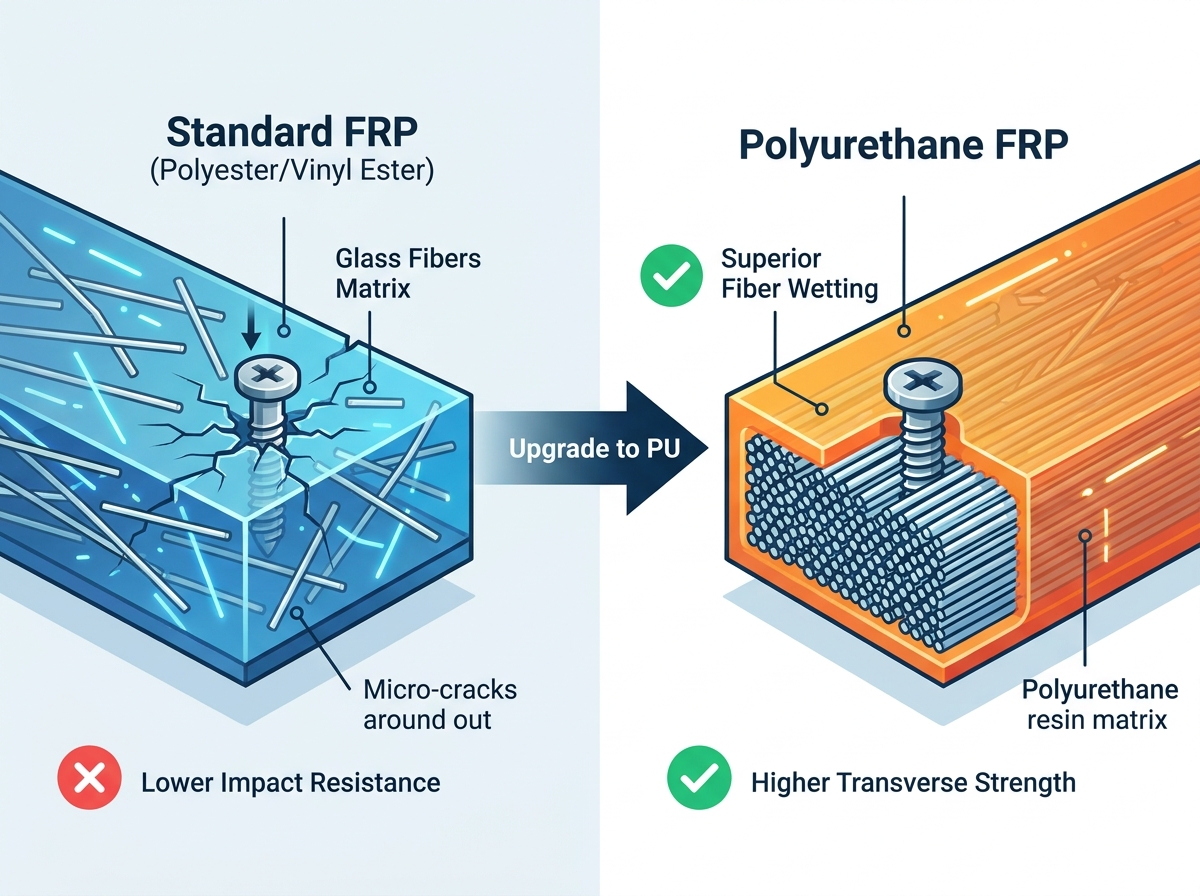
Standard FRP Pultruded Profiles typically rely on unsaturated polyester or vinyl ester resins. These matrices remain highly functional for general architectural use. Yet, they reveal distinct limitations under heavy mechanical stress. Engineers often notice lower screw pull-out strength. They also observe reduced impact resistance during aggressive handling. These brittle tendencies complicate modular assembly processes.
Polyurethane changes the fundamental chemistry of the composite structure. Its unique molecular makeup allows for a superior bond to glass or carbon fibers. Better fiber wetting translates directly to improved load transfer across the composite matrix. PU essentially locks the reinforcing fibers together much tighter than legacy resins. This creates a highly resilient, unified structural member.
You should consider upgrading to PU when specific project demands exceed legacy material capabilities. Look for these core success criteria:
A strict requirement for extreme load-bearing capacity combined with thin wall sections.
The need to completely eliminate galvanic corrosion found in metal-to-metal assemblies.
A demand for aggressive lightweighting without sacrificing structural rigidity.
Projects located in highly alkaline or acidic environments where metals rapidly degrade.
Understanding how polyurethane behaves under stress requires evaluating distinct durability metrics. We must look beyond basic tensile strength to see the real engineering advantages.
PU resin systems offer incredible toughness. They significantly reduce micro-cracking during mechanical fastening, heavy drilling, or blunt impacts. Brittle epoxy or polyester systems simply cannot match this energy absorption. When a forklift accidentally strikes a PU structural column, the matrix absorbs the blow rather than shattering.
Modular assemblies rely heavily on reliable bolted joints. PU matrices deliver exceptionally high screw retention. Pull-out strength increases dramatically compared to standard composites. This gives engineers greater confidence in complex structural frames. You can apply higher torque specifications without fear of stripping the internal composite threads.
Metal structures constantly battle rust and oxidation. PU composites offer total immunity to these issues. Salt-spray degradation becomes a non-issue in coastal environments. You do not need to apply constant anti-corrosion treatments to maintain structural integrity near the ocean.
Industrial environments expose structural components to harsh chemical substances. PU maintains high resistance to aggressive industrial solvents. Acids and alkaline environments rarely compromise its chemical backbone. This makes it highly suitable for chemical processing plants, wastewater treatment facilities, and agricultural infrastructure.
Temperature fluctuations warp many conventional materials rapidly. PU boasts an extremely low Coefficient of Thermal Expansion (CTE). Its CTE closely matches both commercial glass and steel. This prevents bowing and warping in extreme climates. Long-span architectural facades remain straight and visually appealing across decades of seasonal shifting.
Infrastructure must withstand repetitive wind and snow loads. PU provides excellent fatigue resistance against these forces. Cyclic loading rarely induces premature matrix failure. Wind whipping against solar racking systems tests the endurance of any material. Polyurethane absorbs this cyclical kinetic energy effectively, ensuring long-term frame survival.
Engineers often hesitate to switch from familiar materials. Comparing PU directly to aluminum and standard resins highlights the specific engineering tradeoffs.
Aluminum remains a traditional favorite for lightweight structures. However, PU profiles offer comparable strength while remaining significantly lighter. Furthermore, PU components are inherently non-conductive. This proves crucial for electrical enclosures and railway applications. You eliminate the need for secondary grounding protocols.
Aluminum conducts heat rapidly, creating energy loss. PU acts as an excellent thermal insulator. This makes it a definitive choice for window lineals and architectural curtain walls. Energy-efficient building infrastructure relies heavily on eliminating thermal bridging. PU helps modern buildings achieve strict LEED certification standards effortlessly.
Polyester resins possess a higher pre-cure viscosity. PU features a distinctly low pre-cure viscosity. This vital characteristic allows for much denser fiber packing during pultrusion. Manufacturers can achieve up to 80% reinforcement volume. You get much higher tensile strength in considerably smaller cross-sections.
PU raw materials carry a higher initial price tag per pound. However, they enable dramatically thinner profile designs. This offsets the upfront cost through reduced overall material volume. A slimmer, stronger profile also reduces shipping weight and simplifies manual installation on the job site.
Material Performance Comparison Chart
Performance Metric | Aluminum Extrusion | Standard FRP (Polyester) | Polyurethane FRP |
|---|---|---|---|
Strength-to-Weight Ratio | Moderate | Good | Excellent |
Corrosion Resistance | Poor (Galvanic issues) | Good | Excellent |
Thermal Insulation | Very Poor | Good | Excellent |
Impact Toughness | Prone to denting | Prone to micro-cracking | Highly resilient |
Max Fiber Volume | N/A | ~50-60% | Up to 80% |
Transitioning to polyurethane requires understanding the specific manufacturing nuances. You cannot simply swap resins in a legacy pultrusion machine.
Open-bath pultrusion works well for standard polyester. PU requires a completely different approach entirely. Its fast reactivity demands highly controlled closed-injection boxes. You cannot expose the resin to ambient air before fiber wetting. The closed system forcefully injects the low-viscosity PU directly into the dry fiber pack just before entering the heated die.
Poor injection control creates severe structural problems. It leads to dry spots and internal voids. These hidden defects severely compromise overall durability. Water can enter these voids, freeze, and cause catastrophic delamination over time. You must audit a supplier's quality control protocols rigorously.
Buyers must verify a manufacturer's specific track record. Do they have proven dimensional tolerance capabilities? Have they successfully run PU previously? Experience matters greatly here. Request specific case studies detailing their closed-injection process stability over long production runs.
Best Practices for Supplier Vetting:
Request ultrasonic or X-ray testing reports to verify the absence of internal voids.
Review their temperature control data for the injection box system.
Ask for historical batch-to-batch consistency reports.
Demand physical plant tours to inspect their handling of moisture-sensitive PU precursors.
We must address outdoor weathering transparently. Aromatic PU resins will eventually yellow or chalk under direct sunlight. The mechanical strength remains intact, but the cosmetic appearance degrades rapidly. Mitigating this cosmetic degradation requires proactive engineering steps.
You must evaluate the supplier’s specific application methods for exterior use. UV-resistant surface veils, aliphatic PU coatings, or in-line painting provide necessary protection. Common Mistake: Assuming bare PU can withstand direct UV exposure without chalking. Always specify an aliphatic topcoat or a highly engineered synthetic veil for architectural exterior projects.
Moving from conceptual design to actual material procurement requires a disciplined approach. You must define your needs precisely to ensure manufacturing success.
Start by evaluating your required structural shapes. Standard structural shapes like I-beams, C-channels, and tubes exist readily in PU configurations. However, many projects demand custom interlocking frames. Complex geometries often justify the custom tooling investment. PU's excellent flow characteristics allow for highly intricate internal webbing that standard resins struggle to fill.
Never skip physical mechanical testing. Request certified mechanical test data from prospective suppliers. You should specifically look for recognized ASTM standards. Key tests include ASTM D638 for tensile properties, ASTM D790 for flexural strength, and ASTM D256 for Izod impact resistance. Comparing these standardized numbers removes marketing fluff from the decision process.
Moving from material evaluation to actual production requires a structured path. First, finalize the tooling design alongside the pultruder's engineering team. Next, oversee the precise die development process. Finally, request a short pilot run. Use these initial pilot samples to conduct rigorous mechanical fastening tests before authorizing full-scale deployment.
Polyurethane FRP Pultruded Profiles deliver exceptional structural durability. They routinely exceed the performance of both aluminum extrusions and traditional composites. They truly shine when applications demand high transverse strength, total corrosion resistance, and extreme thermal stability.
To successfully integrate these materials into your next project, follow these concise action steps:
Audit your current metal components for signs of corrosion or cyclic fatigue failures.
Identify sub-assemblies where thermal insulation and high structural strength intersect.
Request ASTM-certified mechanical test data for PU matrices from vetted, experienced manufacturers.
Ensure all outdoor applications include specifications for UV-resistant veils or aliphatic topcoats.
Do you face recurring structural pain points with legacy materials? Bring your current CAD drawings to a specialized engineering consultation. A thorough technical review will calculate the exact performance advantages and lifecycle economics of making a material switch today.
A: Yes. In-line painting, UV-resistant veils, or post-pultrusion coatings are standard practices to ensure long-term outdoor aesthetics. Bare aromatic polyurethane will chalk under direct sunlight. Applying an aliphatic polyurethane coating or specialized synthetic veil ensures lasting color retention. This step remains absolutely crucial for architectural facades and infrastructure applications exposed to intense, daily weather conditions.
A: Pultrusion dies generally cost more and take slightly longer to machine than aluminum extrusion dies, making PU ideal for long-term, high-volume, or mission-critical applications where lifecycle ROI outweighs initial setup. The specialized closed-injection boxes required for PU also add complexity to the initial tooling phase. However, eliminating secondary machining and lifetime maintenance easily offsets these upfront costs.
A: No. Due to their high transverse strength, they are actually less prone to splitting or delaminating during drilling, cutting, and routing compared to standard FRP. The tough PU matrix grips mechanical fasteners incredibly tightly. This ensures highly reliable and secure modular assemblies. You can fabricate these profiles using standard carbide-tipped tools without requiring highly specialized machining centers.