
Views: 0 Author: Site Editor Publish Time: 2026-10-22 Origin: Site


Engineers and procurement teams face a critical dilemma when selecting construction materials. Traditional options like steel, concrete, and wood have universally understood load behaviors. Composites, however, often face skepticism regarding verifiable structural integrity. Infrastructure projects demand absolute reliability. Utilizing unverified materials introduces massive engineering liabilities. Specifiers need documented proof before trusting polymers to carry heavy dead loads. This article aims to demystify the compliance, actual load-bearing capabilities, and evaluation frameworks of FRP Pultruded Profiles. We will bypass manufacturer marketing fluff to examine the hard engineering data. You will learn how these composites adhere to international codes. We will explore the specific engineering adjustments you must make regarding deflection and directional strength. You will see how these profiles differ from isotropic metals in structural applications. Ultimately, you will understand exactly how these advanced materials meet stringent global strength standards when engineered correctly.
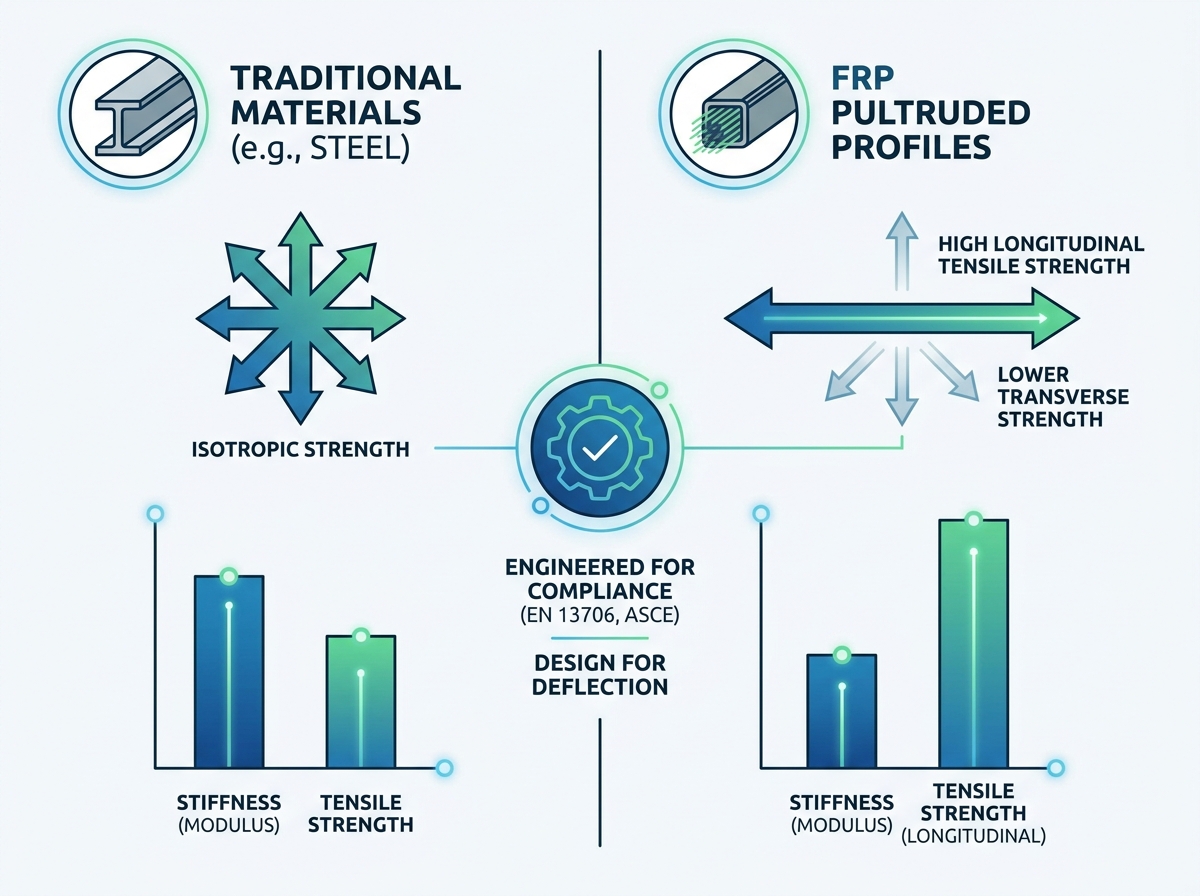
Standards Compliance: Structural-grade FRP pultruded profiles are governed by strict international codes, including European Standard EN 13706 and various ASCE/ASTM frameworks.
Deflection vs. Yield: Unlike steel, FRP design is typically governed by deflection limits (stiffness) rather than ultimate tensile failure.
Anisotropic Reality: Strength is heavily directional; longitudinal strength (along the fibers) is exceptionally high, while transverse strength requires careful joint and connection design.
Verification is Key: Safe implementation requires sourcing from vendors that provide batch-traceable, third-party-tested structural design manuals.
Infrastructure and industrial projects demand modern material solutions. Facilities require components that resist severe corrosion while reducing overall structural weight. However, safety and structural code compliance cannot be compromised. Engineers must guarantee structural stability under dynamic and static loads. This creates a significant evaluation challenge for structural designers.
A viable structural material must meet strict success criteria. It must offer highly predictable load transfer mechanics. The material needs documentable fatigue limits derived from standardized testing. Furthermore, it must adhere seamlessly to local and international building codes. Traditional metals easily meet these criteria due to centuries of standardized use. Composites require a more rigorous validation approach.
Many buyers hesitate precisely because FRP is a composite material. Unlike homogeneous steel, composites consist of glass fibers suspended in a polymer resin matrix. This dual-material nature introduces potential manufacturing variables. Batch inconsistency can occur if manufacturers lack strict quality controls. Variations in the glass-to-resin ratio can drastically alter mechanical properties. If a factory fails to regulate fiber alignment, structural integrity plummets. Therefore, validating these profiles requires shifting focus from simple material strength to comprehensive manufacturing quality assurance.
The industry relies on established international frameworks to ensure safety. These standards dictate testing methodologies, minimum performance thresholds, and design safety factors. Engineers depend on these codes to specify materials confidently.
The European Standard EN 13706 serves as a definitive benchmark for structural profiles. It provides a rigorous classification system based on mechanical performance. This standard strictly regulates the minimum effective flexural modulus of the profile.
E23 Grade: This represents high-performance structural profiles. Materials must achieve a minimum effective flexural modulus of 23 GPa. Engineers specify E23 for primary load-bearing structures.
E17 Grade: This classification covers standard-performance profiles. The material must reach a flexural modulus of 17 GPa. Designers typically use E17 for secondary structural elements like handrails or light-duty walkways.
By relying on EN 13706, designers remove guesswork. They can order materials knowing exact minimum stiffness values are legally guaranteed by compliant manufacturers.
North American engineering practices rely heavily on the American Society of Civil Engineers (ASCE). The ASCE Pre-Standard for Load & Resistance Factor Design (LRFD) of Pultruded FRP Structures is critical. It provides engineers with reliable safety factors and load combination formulas. It bridges the gap between traditional steel design and modern composite realities.
Additionally, manufacturers must prove their claims through rigid ASTM testing methods. You should always demand transparency regarding these specific tests:
ASTM D638: Determines ultimate tensile properties and longitudinal yield strength.
ASTM D790: Evaluates flexural properties, revealing how the material behaves under bending stresses.
ASTM D2344: Measures the apparent interlaminar shear strength, critical for beam design.
Certain industries impose secondary standards that impact strength requirements in specific contexts. For example, the Cooling Technology Institute (CTI) standardizes profiles used in cooling towers. These profiles must maintain structural strength while constantly exposed to moisture and biological hazards. Offshore and marine applications demand DNV approvals. DNV certification ensures the structural components withstand harsh saline environments and severe wave impacts without degrading mechanically.
To design safe structures, you must understand how composite mechanics differ from isotropic metals. Steel behaves the same way regardless of load direction. Composites behave entirely differently based on fiber orientation. This distinction is the core of structural evaluation.
High-quality FRP Pultruded Profiles can match or even exceed structural steel in tensile strength. When compared on a pound-for-pound basis, pultruded composites demonstrate exceptional load-carrying capacity. However, you must emphasize a critical caveat. This immense strength exists only along the longitudinal axis. Pultrusion pulls continuous glass rovings linearly through the die. Therefore, pulling the material along its length leverages the full strength of the glass fibers.
Compressive strength also performs exceptionally well longitudinally. However, off-axis loads drop in strength significantly. Engineers must account for this anisotropic reality during the initial design phase.
We must transparently state a fundamental mechanical limitation. FRP has a significantly lower modulus of elasticity than standard structural steel. While the material will not break easily, it will bend far more under the same load. Deflection governs almost all composite design.
Because stiffness limits the design, engineers cannot execute a direct geometry swap with steel. You must upsize the composite profiles to increase the moment of inertia. Alternatively, you can adjust the structural span lengths. Placing supports closer together prevents excessive bending and ensures user comfort on platforms or walkways.
Table 1: Generalized Mechanical Property Comparison (Longitudinal Axis)
Material Type | Tensile Strength (MPa) | Modulus of Elasticity (GPa) | Density (g/cm³) | Design Governing Factor |
|---|---|---|---|---|
Standard Structural Steel (A36) | 400 - 550 | 200 | 7.8 | Yield Strength |
FRP Pultruded Profile (E23 Grade) | 300 - 450 | 23 - 28 | 1.8 - 2.0 | Deflection / Stiffness |
Aluminum Alloy (6061-T6) | 310 | 69 | 2.7 | Deflection / Yield |
Composites excel in environments requiring high fatigue and impact resistance. Unlike metals, which can suffer from micro-cracking and eventual fatigue failure under cyclical loads, composites absorb stress differently. The resin matrix distributes impact energy across millions of individual fibers. The material absorbs elastic deformation without permanently yielding. If designed correctly, pultruded components exhibit superior longevity in high-vibration environments like bridge decks or industrial processing floors.
Understanding where materials excel is important. Knowing exactly how they fail is critical for structural safety. Most structural failures in composite applications stem from improper design adjustments rather than defective material.
You cannot bolt composite members exactly like steel. This is the most common mistake inexperienced designers make. Steel deforms plastically around a bolt hole, redistributing localized stress. FRP does not yield plastically; it remains elastic until failure. Stress concentrations at drilled holes can quickly lead to sheer-out or bearing failure.
Best Practices for Connections:
Avoid relying solely on heavy bolting for primary load transfer.
Use specialized mechanical fasteners equipped with oversized washers to distribute bearing stress.
Incorporate high-strength structural adhesives to create bonded joints, reducing reliance on mechanical holes.
Design reinforced joint geometries that account for transverse weakness.
While immune to traditional rust, polymer resins face distinct environmental threats. Long-term ultraviolet (UV) exposure degrades unprotected resin surfaces, causing fiber blooming. Extreme temperatures also pose structural risks. As ambient heat approaches the resin's glass transition temperature (Tg), the matrix softens. This softening drastically compromises overall structural integrity.
Manufacturers mitigate these risks during pultrusion. They incorporate synthetic surface veils to create a resin-rich protective barrier. They also blend chemical UV inhibitors directly into the resin bath. For high-heat environments, engineers must specify high-Tg resins, such as premium vinyl esters, to maintain safe load ratings.
Polymers exhibit viscoelastic behavior. Over decades of sustained dead loading, the material will slowly deform. This phenomenon is known as creep. Steel does not creep at standard atmospheric temperatures, so traditional engineers often overlook this parameter.
When designing with composites, you must apply conservative reduction factors for long-term dead loads. Structural design manuals provide specific creep coefficients. Engineers use these coefficients to predict 50-year deflection limits. Ignoring creep will result in structures that gradually sag beyond acceptable serviceability limits.
The engineering theories above only hold true if the manufactured product is flawless. Vetting your supply chain is a critical structural engineering task. You must separate reliable manufacturers from those producing inconsistent batches.
Never accept marketing brochures as structural evidence. Reject vendors who only provide in-house testing data. You must require certified coupon testing results from accredited independent laboratories. Third-party verification ensures the tensile, flexural, and shear numbers provided are accurate and unbiased. If a manufacturer hesitates to share independent lab reports, eliminate them from your vendor list.
A reputable supplier understands that engineers need actionable data. Shortlist suppliers who provide detailed structural design manuals. These documents should follow standard LRFD or Allowable Stress Design (ASD) methodologies. The manual must provide clear strength reduction factors for their specific proprietary profiles. It should cover section properties, connection detailing, and temperature degradation curves.
Batch consistency dictates structural safety. Ensure the manufacturing facility strictly adheres to ISO 9001 standards. You should inquire about their resin-to-glass ratio monitoring systems. Modern pultrusion requires digital sensors to regulate bath temperatures and pulling speeds. Furthermore, demand comprehensive lot traceability. If a specific structural beam fails in the field, you must be able to trace it back to the exact manufacturing shift and raw material batch.
FRP pultruded profiles are highly engineered structural components. They confidently meet the most rigorous industrial standards when designed and sourced correctly. While their anisotropic nature and lower stiffness require distinct design approaches, their high strength-to-weight ratio makes them indispensable for modern infrastructure.
To safely implement these materials, remember these action-oriented next steps:
Shift your design mentality from yield-based engineering to deflection-governed engineering.
Always specify distinct connection methodologies rather than copying standard steel bolting patterns.
Demand documented compliance with EN 13706 or ASCE pre-standards from your suppliers.
Request physical material samples (coupons) and a manufacturer's structural design guide to share with your engineering team for a pilot span calculation.
A: Geometrically, no. Because FRP has a lower modulus of elasticity, an exact 1:1 size replacement will likely deflect more than steel. Engineers typically redesign the profile geometry (e.g., using a deeper web) to achieve equivalent stiffness.
A: Strength decreases as temperatures approach the resin matrix's glass transition temperature (Tg). High-heat environments require specific high-Tg resins (like specialized vinyl esters or epoxies) to maintain load ratings.
A: Yes, increasingly so. Frameworks like the IBC (International Building Code) allow for FRP through alternative materials clauses, relying heavily on ASCE LRFD pre-standards and certified manufacturer test data.
A: With proper UV protection and within specified temperature ranges, FRP structures regularly demonstrate 50+ year service lives with minimal strength degradation, vastly outperforming steel in corrosive environments.