
Views: 0 Author: Site Editor Publish Time: 2026-10-27 Origin: Site


Structural engineering is experiencing a major shift toward hybrid material systems. Engineers no longer rely on single-material solutions to solve complex design challenges in extreme environments. Polyurethane (PU) resin is already superior to standard polyester or vinyl ester in terms of shear strength and fiber wet-out. This makes it a prime candidate for manufacturing complex FRP Pultruded Profiles.
Manufacturers frequently ask a core production question. Can they co-pultrude, embed, or layer dissimilar materials like metals, thermoplastics, or carbon fiber into PU profiles without compromising structural integrity or inflating costs?
The short answer is yes. However, success depends entirely on managing thermal expansion coefficients (CTE), interface bonding chemistry, and tooling design. In this guide, you will learn how to evaluate these variables, select proven material combinations, and navigate the manufacturing realities of hybrid pultrusion.
Hybrid viability: Polyurethane’s superior adhesive properties make it easier to combine with carbon fibers, metallic inserts, and protective veils compared to traditional resins.
Primary combinations: The most proven combinations involve hybrid fiber reinforcements (glass + carbon) and embedded conductive elements (copper wire or metallic strips).
The primary risk: Delamination at the material interface due to differing coefficients of thermal expansion (CTE) during the exothermic curing process.
ROI threshold: Multi-material pultrusion requires higher upfront tooling costs and slower line speeds; it is best reserved for high-performance applications like photovoltaic (PV) frames or aerospace components.
Pure glass-fiber polyurethane profiles deliver exceptional strength and low weight. However, they naturally lack specific functional properties. They are electrical insulators, meaning they cannot ground currents. They also have uniform stiffness, which may not satisfy localized load requirements. Furthermore, raw polyurethane requires surface modifications to resist prolonged ultraviolet exposure.
By hybridizing these profiles, you can bypass these limitations. You achieve multi-functional components directly from the pultrusion line. The business case for creating hybrid composites revolves around a few core advantages:
Targeted weight reduction: You can mix expensive carbon fiber into the profile only where structural load demands it. You maintain cheaper E-glass for the bulk of the matrix, optimizing material budgets.
Assembly elimination: Embedding fastening points or grounding wires directly into the profile during manufacturing removes secondary drilling and bonding steps on the factory floor.
Enhanced localized rigidity: Co-pultruding metallic strips into highly stressed flanges prevents deflection in long-span architectural or automotive applications.
Success requires strict validation. The final composite must perform as a monolithic structure under load. A hybrid profile must pass standard shear and peel tests, such as ASTM D2344, without interfacial failure. If the layers delaminate under stress, the component fails immediately. You must engineer the interface so the bond between the PU matrix and the secondary material exceeds the shear strength of the resin itself.
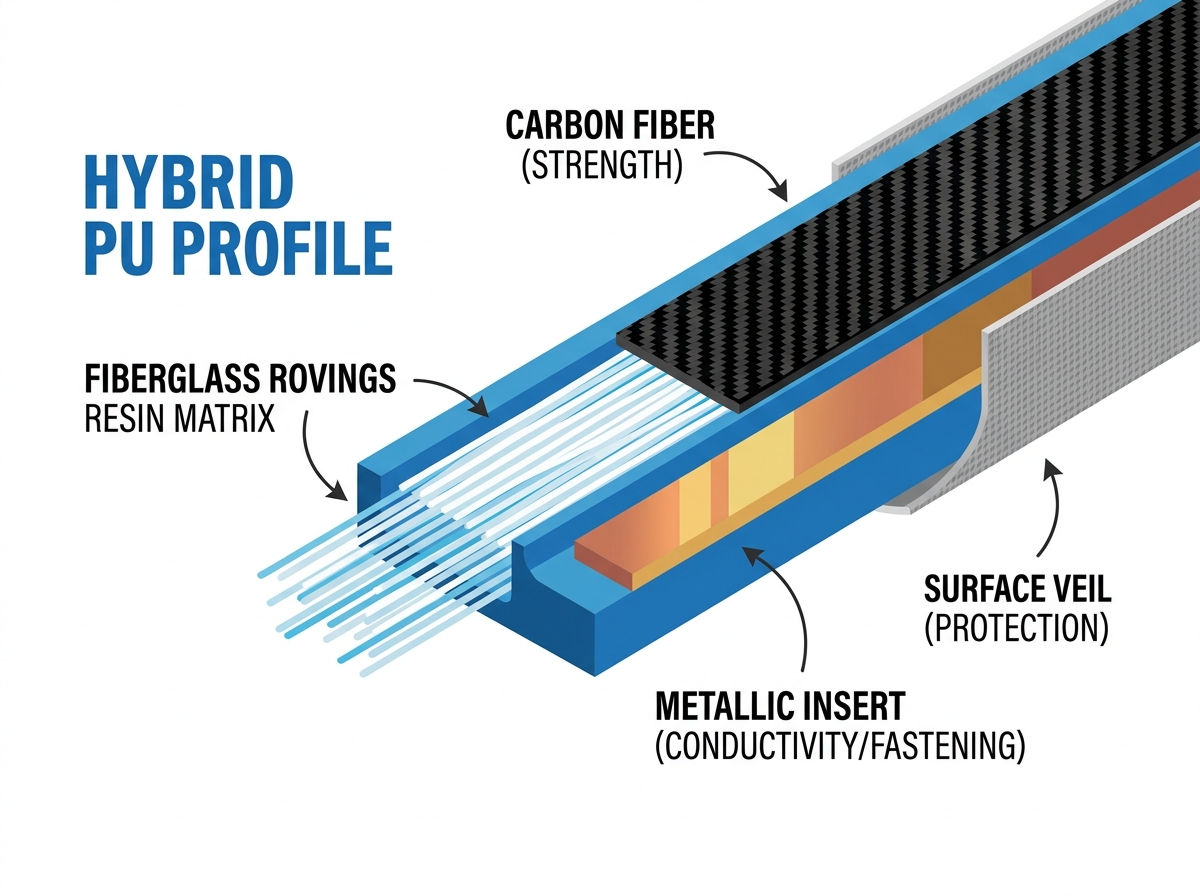
Polyurethane boasts exceptionally low viscosity before it cures. You can utilize this low viscosity to wet out highly dense carbon fiber tows alongside standard E-glass roving. Traditional resins often struggle to penetrate tight carbon bundles, leaving dry spots. Polyurethane flows easily into these microscopic voids, ensuring complete encapsulation.
Strategic placement dictates performance. You must choose between core layering and skin layering for optimized flexural modulus. Placing carbon fiber on the outer skins maximizes stiffness and bending resistance. Conversely, placing carbon in the core improves axial tension strength. This hybrid approach lets you fine-tune the mechanical behavior of FRP Pultruded Profiles without paying for a 100% carbon structure.
Embedding metallic strips like aluminum, steel, or copper provides localized nodes for structural fastening. In applications like photovoltaic (PV) frames, embedded copper wire offers vital electrical grounding throughout the mounting structure. You achieve both support and safety in a single continuous pull.
Preparation requirements define the success of this combination. Metal inserts require intense preparation before they enter the PU resin bath. Smooth metal repels chemical bonding. You must apply mechanical scoring, sandblasting, or chemical adhesion promoters (like silane coupling agents) to the metal surface. This creates a microscopic texture, giving the polyurethane mechanical interlocking points to grip permanently.
Fiber blooming occurs when exposed glass fibers break through the resin surface, creating a rough, itchy texture. Applying polyester or continuous strand mats as a surface veil pushes the structural fibers deeper into the profile. This leaves a smooth, resin-rich outer layer.
Polyurethane is inherently sensitive to UV degradation. It will yellow and chalk over time when exposed to sunlight. To prevent this, manufacturers apply in-line UV coatings or co-extrude thermoplastic jackets directly post-die. Adding weatherability layers immediately protects the matrix, extending the lifespan of outdoor architectural and structural profiles.
You cannot simply throw two materials together and expect them to bond. Rigorous engineering evaluation separates successful hybrid composites from dangerous failures. You must scrutinize thermal dynamics, mechanical adhesion, and regulatory compliance.
Thermal Expansion Compatibility (CTE)
Polyurethane cures exothermically, generating significant heat inside the die. As the profile exits the die and cools, it shrinks. If you embed a material with a vastly different Coefficient of Thermal Expansion (CTE), extreme mismatches will cause internal micro-cracking during the cooling phase. For instance, aluminum expands and contracts at a much higher rate than fiberglass-reinforced PU. If not managed through die temperature profiling and flexible interface agents, the aluminum will tear away from the resin as it cools.
Table 1: Typical Coefficient of Thermal Expansion (CTE) Comparisons
Material Type | Approximate CTE (10⁻⁶ / °C) | Compatibility Risk with PU Composite |
|---|---|---|
Glass-Reinforced Polyurethane | 8 - 12 | Baseline (Reference Matrix) |
Carbon Fiber (Axial) | -1 to +2 | Medium (Requires specific sizing/wet-out) |
Aluminum | 21 - 24 | High (Requires surface treatment and slow cooling) |
Steel | 11 - 13 | Low (Closely matches glass-reinforced PU) |
Interface Shear Strength
You must evaluate the bond between the PU matrix and the secondary material carefully. Address the common industry myth: "PU sticks to everything." While polyurethane has excellent adhesive qualities, smooth, non-porous surfaces require physical intervention. You should perform lap shear testing to quantify the force required to break the interface. If the bond fails before the resin itself fails, you need a stronger chemical primer or rougher mechanical abrasion.
Compliance & Standardization
Adding conductive materials to inherently insulating profiles changes the electrical classification of the part. Standard glass-reinforced structures are transparent to radio frequencies and resist electrical currents. If you embed a copper grounding wire, the profile becomes conductive. This requires updated UL or CE testing. You must alert your compliance teams early, as these regulatory shifts mandate new safety validations for the final assembly.
Designing a hybrid profile is only half the battle. Pulling it successfully on a continuous manufacturing line introduces significant physical risks. You must prepare your production facility for increased complexity.
Tooling and Die Complexity
Adding secondary materials frequently requires custom guide plates positioned just before the die entrance. These plates maintain strict tension and precise alignment of the embedded metal or carbon fibers. If a metallic strip drifts even a millimeter off-center, it may breach the surface of the profile. Misalignment leads directly to part rejection and wasted resin. You will likely spend more on advanced tooling design to guarantee this alignment.
Line Speed Trade-offs
Polyurethane already requires specific, tightly controlled temperature zones for its exothermic reaction. Introducing cold materials, like thick metal wire, alters the thermal mass inside the die. The cold metal absorbs heat away from the curing resin. To compensate, operators often force slower pull speeds to ensure the resin reaches its critical curing temperature. Slower line speeds decrease daily output and increase unit processing costs.
Quality Assurance Risks
Visual inspection cannot detect internal bonding failures. Hidden voids or dry spots occur where the PU resin fails to penetrate completely around an inserted material. Non-destructive testing (NDT) becomes mandatory for hybrid parts. You will need to implement ultrasonic scanning or X-ray inspection to detect delamination beneath the surface. These extra quality assurance steps require specialized equipment and trained personnel.
Not every project requires hybridization. You must weigh the upfront engineering friction against long-term operational savings. Use clear shortlisting logic to determine when a multi-material approach makes sense.
When to proceed:
You should pursue co-pultrusion for high-volume, standardized applications. If the reduction in secondary assembly labor outweighs the increased pultrusion tooling costs, you have a winning business case. Solar mounting structures, transit bus flooring, and standard aerospace stringers fit this profile. In these scenarios, embedding functional elements during pultrusion saves thousands of manual labor hours down the line.
When to pivot:
Avoid multi-material dies for low-volume runs, initial prototypes, or highly customized bespoke projects. Designing a custom co-pultrusion die is expensive and time-consuming. For small batches, post-machining a standard FRP Pultruded Profiles—such as mechanically fastening an aluminum rail to a standard PU beam—is almost always cheaper and faster.
Next steps for procurement and engineering:
If you decide to proceed with a hybrid design, follow a phased validation approach to minimize financial risk:
Request coupon testing from your pultruder to verify lap shear strength between your chosen materials.
Perform thermal cycling tests on the coupons to observe how the CTE mismatch affects the bond under extreme temperature shifts.
Approve the chemical sizing and surface treatments before funding the full die creation.
Commission a short prototype pull to validate internal guide plate alignment and final line speeds.
Combining other materials with polyurethane FRP profiles is both technically viable and highly advantageous. However, it requires rigorous interface engineering. You cannot ignore the physical laws governing thermal expansion and mechanical adhesion. By preparing metal inserts correctly, placing carbon fiber strategically, and adjusting die temperatures, you can create superior multi-functional composites.
Polyurethane’s inherent strength and exceptional wet-out capabilities make it the best resin matrix for these demanding hybrid applications. It grips secondary materials far better than traditional polyester resins.
Before launching your next project, advise your engineering teams to gather exact load requirements, CTE tolerances, and environmental exposure data. Bring this comprehensive data to your pultrusion partner early in the design phase. By testing lap shear strength and prototyping guide plates upfront, you ensure a smooth, profitable transition into multi-material manufacturing.
A: Yes, but the aluminum must be surface-treated, and the die must be specifically designed to handle the differing thermal expansion rates during the heat-curing phase to prevent delamination.
A: Yes, compared to a 100% carbon fiber profile. Strategic placement of carbon fiber in high-stress zones while using fiberglass for the bulk structure optimizes both cost and stiffness.
A: If the metal is completely encapsulated by the polyurethane resin and glass matrix, corrosion resistance remains intact. However, if the profile is cut or drilled post-pultrusion, the exposed metal will require sealing.
A: Depending on the complexity of the internal guides and the materials being introduced, tooling design and initial prototyping typically range from 8 to 14 weeks.