
Views: 0 Author: Site Editor Publish Time: 2026-06-28 Origin: Site


Fiber Reinforced Polymer (FRP) pultrusion represents a strategic leap in structural engineering. It goes far beyond a simple manufacturing method. You can now use these engineered composites as reliable alternatives to steel, aluminum, and timber in highly corrosive or high-stress environments. Traditional structural materials often suffer from severe pain points. Metals rust and degrade continuously. They also require heavy installation equipment and force frequent maintenance downtime. These operational interruptions create massive logistical headaches. This article provides structural engineers and procurement teams with a clear framework. You will learn how to evaluate, specify, and source structural profiles accurately. We will guide you through material properties, shape functionality, and vendor vetting processes. By the end, you will possess a solid understanding of how to implement these advanced composites into your most demanding infrastructure projects seamlessly.
Consistent Strength: The pultrusion process creates continuous, uniform profiles with exceptionally high strength-to-weight ratios compared to traditional metals.
Material Specificity: Choosing between standard Glass Fiber FRP Pultruded Profiles and advanced PU FRP Pultruded Profiles dictates load capacity, flexibility, and project budget.
Shape-to-Function Mapping: Standard structural geometries (like Square Tube FRP Pultruded Profiles) are engineered as direct replacements for standard steel shapes, requiring specific fastening adaptations.
Vendor Vetting: Reliable procurement relies on verifying third-party mechanical testing (e.g., ASTM standards), UV resistance ratings, and strict quality control on fiber volume fractions.
Engineers often compare pultrusion directly against extrusion. Extrusion pushes melted plastics through a die to form shapes. Pultrusion operates entirely differently. It pulls continuous fiber rovings through a liquid resin bath. Next, pulling mechanisms drag these saturated fibers through a heated steel die. The heat activates the resin catalyst. This cures the composite into its final rigid shape as it exits the machine. This pulling action aligns the fibers perfectly along the longitudinal axis.
This automated alignment achieves a incredibly dense fiber volume. Most profiles maintain a fiber-to-resin ratio between 50% and 70%. This high density translates directly to massive longitudinal tensile strength. The material resists pulling forces exceptionally well. Engineers rely on this predictability for heavy structural applications.
Consider the lifespan extensions possible in highly corrosive environments. Chemical processing plants and offshore oil rigs destroy steel rapidly. Saltwater and airborne chlorides accelerate oxidation. By switching traditional metals to GRP FRP Pultruded Profiles, facility managers eliminate rust entirely. Structural lifespans easily double or triple. You avoid the constant chipping, painting, and welding repairs required for metal frameworks. The operational continuity achieved makes this material transition highly strategic.
Process Feature | Pultrusion (Composites) | Extrusion (Plastics/Metals) |
|---|---|---|
Forming Action | Continuous pulling under tension | Continuous pushing under pressure |
Internal Reinforcement | High-density continuous fibers | None or short chopped fibers |
Structural Strength | Exceptionally high (load-bearing) | Low to moderate (non-structural) |
Dimensional Stability | Rigid, minimal thermal expansion | Flexible, higher thermal expansion |
Your base material choices determine the ultimate success of the project. You must select the right matrix to protect the internal fibers. The industry divides these matrices into standard formulations and highly specialized combinations.
This category represents the undisputed industry standard. It provides an excellent balance of properties. You gain high electrical insulation and superior chemical resistance. Manufacturers typically offer two primary resin options here: polyester and vinyl ester. Polyester serves perfectly for general structural applications. It handles mild weathering and structural loads effectively. Vinyl ester steps up the chemical defense. It handles aggressive acids and caustics easily. Specifying Fiberglass FRP Pultruded Profiles ensures reliable, long-term performance across most industrial settings.
Some engineering challenges require a high-performance alternative. Traditional polyester resins have inherent limitations regarding impact tolerance. Polyurethane changes the structural dynamics entirely. It binds the glass fibers much more tenaciously. Polyurethane FRP Pultruded Profiles offer vastly superior transverse strength compared to standard matrices. They absorb sudden impacts without shattering.
This specific matrix allows engineers to design components using thinner walls. You drop the overall weight without sacrificing the required load capacity. When you integrate PU FRP Pultruded Profiles into a system, you actively solve specific failure modes. It acts as the ideal choice for weight-critical transportation infrastructure and high-impact industrial zones.
Best Practices for Resin Selection:
Assess the maximum ambient operating temperature in your specific application zone.
Identify the exact chemical exposures the profiles will face daily.
Evaluate potential impact risks from nearby equipment or vehicles.
Verify fire retardancy requirements required by local building codes.
Transitioning from metal drawings to composite specifications requires careful shape mapping. You cannot simply swap materials blindly. The modulus of elasticity differs significantly. Engineers must accommodate these material behaviors through proper geometric choices.
Primary load-bearing columns utilize this geometry frequently. Modular structural frameworks depend heavily on their symmetric stability. Standard Square Tube FRP Pultruded Profiles replace heavy structural steel columns perfectly. They provide excellent torsional resistance. Designers also rely on them for heavy-duty handrail stanchions in corrosive plants. Their flat sides make mechanical fastening straightforward and secure.
Horizontal beams and floor joists require strong deflection resistance. Cross-bracing systems also benefit immensely from this shape. Because composites deflect more than steel under identical loads, geometry matters. You must calculate load-deflection metrics accurately before finalizing designs. Utilizing properly sized Rectangle Tube FRP Pultruded Profiles gives you the necessary stiffness for spanning long horizontal distances securely.
Ergonomics play a major role in handrail design. Operators need a comfortable, secure grip. Radar transparency matters deeply for antenna radomes and telecommunication towers. Round Tube FRP Pultruded Profiles deliver exceptional ergonomic comfort. They completely lack radio frequency interference. You will also see them used widely as heavy-duty tool handles in electrical environments due to their non-conductive nature.
Sourcing structural composites demands strict quality verification. These materials hold up critical infrastructure. You must look beyond simple dimensions.
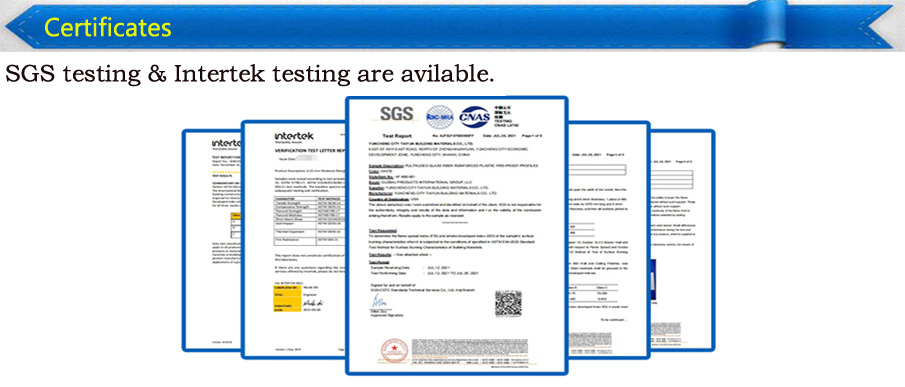
First, demand comprehensive Technical Data Sheets (TDS) from every potential manufacturer. You must scrutinize the tensile strength, flexural modulus, and compressive strength figures. Do not accept vague performance claims. The data must align with recognized international testing standards.
You should verify the following core certifications during vendor audits:
ASTM D638: Validates the ultimate tensile properties of the composite matrix.
ASTM D790: Confirms the flexural properties necessary for horizontal beam loading.
ASTM D695: Establishes the compressive strength required for vertical column applications.
Visual and dimensional tolerance checks reveal the true manufacturing quality. You should know how to spot common production defects. Dry fibers indicate a severe lack of resin wetting during the bath stage. Surface cracking suggests improper thermal control during the curing phase. Dimensional warping means the die pulling speed was improperly calibrated. A reliable supplier of Glass Fiber FRP Pultruded Profiles prevents these issues through strict automated quality control.
Finally, evaluate the custom versus off-the-shelf logic. When should you pay for custom die tooling? If your project demands unique interlocking mechanisms or specialized aerodynamic shapes, custom tooling makes perfect sense. Otherwise, standard FRP Pultruded Profiles cover the vast majority of structural engineering requirements effectively. Utilizing existing dies accelerates your project timeline drastically.
Engineers must acknowledge practical field constraints. Designing composites requires different techniques than designing traditional metal structures. Ignorance of these differences leads to premature mechanical failures.
Fastening challenges represent the most significant adjustment. You cannot weld these materials. Standard joining requires specialized structural adhesives. When mechanical fastening is necessary, through-bolting requires heavy backing plates. Backing plates distribute the clamping load safely across a wider surface area. Drilling holes cuts the continuous fibers. This creates localized stress concentrations. You must maintain generous edge distances when detailing connection points.
Directional strength limitations require careful load path planning. We must state transparently that longitudinal strength is exceptional. However, transverse or crosswise strength remains considerably lower. The pultrusion process aligns fibers primarily in one direction. You must design your connections to avoid excessive crosswise bending moments.
UV degradation poses a long-term environmental risk. Prolonged sun exposure causes a phenomenon called "fiber bloom". Ultraviolet light degrades the surface resin layer slowly over time. Exposed glass fibers then catch dirt and moisture. You must mandate UV-inhibited resins for exterior applications. Applying a synthetic polyurethane surface veil during the pultrusion process blocks UV rays highly effectively.
Supply chain constraints also affect project planning. Custom profiles require minimum order quantities (MOQs) to justify the setup time. Global shipping demands careful logistical coordination. Bulky structural lengths fill shipping containers very quickly. You should plan your procurement cycles well in advance of the installation dates.
These advanced structural elements represent highly engineered solutions, not generic commodities. Their successful implementation demands a deep understanding of material properties, geometric behaviors, and precise fabrication techniques. You must evaluate the operational environment accurately before specifying resin systems or fiber configurations.
Your next steps should focus heavily on accurate preparation. First, calculate your exact load and deflection requirements. Next, request detailed technical data sheets and physical material samples from short-listed suppliers. Finally, initiate thorough vendor capability audits to ensure full compliance with international testing standards. Taking these proactive steps ensures a resilient, long-lasting structural installation.
A: GRP stands for Glass Reinforced Plastic. It represents a specific subset of the broader FRP (Fiber Reinforced Polymer) family. While the FRP category can include advanced carbon or aramid fibers, GRP exclusively utilizes continuous glass fibers as the primary structural reinforcement within the resin matrix.
A: Yes, you can cut these profiles directly on-site. However, standard steel saw blades dull extremely quickly. You must use diamond-coated blades or specialized carbide-grit blades for clean, safe cuts. Workers must also wear proper personal protective equipment, including fine-particulate dust masks and sealed goggles.
A: Polyurethane matrix profiles deliver significantly higher transverse strength and impact resistance. While standard resins provide excellent baseline capabilities, PU allows engineers to design components utilizing thinner walls while maintaining strict structural integrity. This superior performance ratio justifies its specification in highly demanding, weight-critical infrastructure projects.
A: You can expect an exterior service life easily exceeding 25 to 50 years. This duration depends heavily on the specific environmental exposure and implemented surface treatments. Applying specialized UV veils and advanced resin formulations prevents solar degradation, allowing the material to far outlast traditional metals.